Blog

  • The Great Reidy Road Trip: Part One

    Nearing the end of our seven month adventure, it was time to embark on a three week road trip around England, Wales, Scotland and Ireland.

    Our itinerary was blank so we relied on a lot of tips from the people we came across during our travels who hailed from the UK.

    Our first stop was England where we flew into London and picked up our little hire car which was by far an improvement on the Icelandic shitbox…

    1F6E5BBE-5814-457F-9258-9FBEF57D65C2

    After a short overnight stay in the burbs, we made our way out of London and to the Stonehenge in Wiltshire.

    62E01FA3-24B2-40CA-9058-7E1782A9FE9F

    We decided to save ourselves 30£ and found a little trick online to see them up close for free. By dodging some potholes down a public dirt road and taking the footpath behind the tourist bus stop, you can see the Stonehenge up close for free. #winning


    The English countryside is so green (thanks to all that rain) and we found ourselves stopping every 10 minutes to take photos of the farmlands, rolling hills and old stone farmhouses.

    32D152C1-8185-46F4-82BC-3BF3B585D5A6

    Our first night’s stop was the town of Bath and we were greeted with dark clouds and heavy rain. Who would’ve thought England in November could be so wet and cold 😕

    We delayed a visit into town and waited until the sun was shining the next morning.

    8E4808EE-5C94-4450-BA11-BEBB7CFA7233

    Day two began with a visit to the Bath Cathedral which was stunning inside and out, before exploring the Roman Baths.


    The Roman Baths are a well preserved archaeological site and visiting the museum gives you a good picture of just how far the Roman Empire once reached during its reign. The Roman baths were part of the day-to-day life in Ancient Rome and visiting the site was a worthwhile stop.


    Our road trip continued through the Cotswolds area before stopping in Stratford Upon Avon to see the birthplace of William Shakespeare.


    We continued driving to our next overnight stop, a tiny town just outside of Betswy Y Coed in Wales.


    The sun sets quite early this time of year so it was too dark to visit anything but the local pub for an early dinner. The next morning we made our way to Snowdonia National Park and drove through some of the most beautiful countryside so far.


    The rain would be our constant nemesis on this trip and spoiled our plans for a 14km return hike to Snowdon – the highest peak in the Snowdonia National Park. Instead, we made it as far as this beautiful waterfall and some lookout points…


    Calling it quits on hiking we continued to Conwy and wow, this town can give Dubrovnik a run for its money! We drove into the old town which was surrounded by medieval town walls. Added bonus – you can walk the walls for free!

    We also toured the Conwy Castle which overlooks the town and surrounding ocean. The castle is a medieval fortification built by Edward I during his conquest of Wales between 1283 and 1289.

    Looking for a spot to eat lunch, we stumbled upon a great little drive around a place called Gogarth. The one way road is called Marine Drive and for a 3£ toll, you can drive up to the peak and around the ocean road which has incredible views and cliffside caves.

    We stayed in Conwy overnight and the next morning made our way back across the border to England to explore the Lake District National Park.

    Blue skies and green mountains, the Lake District is a beautiful part of the U.K. We drove to Newlands just outside of Keswick to hike the Catbells Peak which overlooks Derwent Water.

    By the time we made it to the hiking trail, the blue skies turned into heavy rain. We eventually caught a break in the downpour and hiked the short trail to the top for these views…

    A hearty English pub meal and a couple of pints in Keswick thawed us out and warmed our bellies.

    Day two and we planned a busy day, starting with Ullswater and stopping at Pooley Bridge…

    …and Aira Force where we did a short hike to some stunning falls.

    Next stop was Buttermere and the drive was just as amazing if not better than the lake views!

    Just when we thought the views couldn’t get any better, we took an “off the beaten track” road around the far side of Derwent Water, where we found ourselves in the middle of this…

    1B7BD275-6BAD-4190-BE29-8F9615983DDF

    The English and Wales countryside was really something else and while the weather left a lot to be desired, the spectacular scenery more than made up for it.FA475063-10B7-4243-BF4B-0C6C0F736931

    Stay tuned for Part Two of The Great Reidy Roadtrip!

  • The land of fire and ice

    The Northern Lights may have evaded us, but our week in Iceland – often called ‘the land of fire and ice’ – nonetheless produced some of the most spectacular landscapes of our trip to date.

    414F150C-0CAA-486E-B39D-28B9F81C9F17

    After arriving in the capital Reykjavík, picking up our shitbox hire car and checking into our Airbnb apartment, we planned four big days of all Iceland has to offer – national parks, glaciers, geysers, hot springs, volcanoes and lava caves!

    006432BA-2A11-4AA9-85FA-A2CCE0C3DD68

    We started with Iceland’s most visited national park, Thingvellir, just 45 minutes outside the city.

    The park’s sights include Flosagja canyon, Oxararfoss Waterfall and the largest lake in Iceland, Thingvallavatn.

    Underneath the lake is where two major tectonic plates famously meet – the North American plate to the west and the Eurasia plate to the east. This meeting of two major plates creates much of the unique geological and volcanic activity that defines the island nation.

    Some visitors even braved the freezing cold waters to snorkel over the top of the crevasse!

    Thingvellir has wider cultural significance to Icelanders as the area had been the meeting place of the national Parliament from the 10th to the 18th centuries.

    ‘Law rock’, which housed the old court, was a popular spot for sightseers, as was the Prime Minister’s modest summer residence, which is still used to this day.

    We then travelled to the famous Strokkur Geyser, where the water temperature sits at 80-100 degrees, and watched it boil and erupt 20 metres into the air a few times. Jess suggested Tom dip his toes in the water (yep, seriously) but thankfully he’s too clever for that.

    Our last stop for the day was the Gullfoss Falls. We’d see several impressive waterfalls in Iceland, but as a key stop on the well-worn Golden Circle, this is the most visited and photographed.

    That night would be the first of a few unsuccessful attempts to see the northern lights (or more scientifically, the ‘Aurora Borealis). After dinner we drove back out near the national park, found a dark spot and sat for what we planned to be quite a few hours waiting.

    However before long heavy cloud cover came over so we called it a night. Heavy clouds and low Aurora activity would continue the whole week unfortunately.

    The next day we were very excited to be doing a guided glacier walk – for many a ‘must do’ activity in Iceland.

    We drove two hours south in pouring rain (and darkness, with Iceland’s sun not rising until 10am), until we reached the Sólheimajökull Glacier.

    0283E846-1B7E-41D1-A4E8-1C2D397D8E1C

    The Sólheimajökull Glacier is about 30km long and fed by one of Iceland’s 10 or so massive ice caps (this one, called ‘Mýrdalsjökull’ covers 600 square metres yet is still nowhere near the largest).

    We had a guide all to ourselves and it was a surreal experience climbing up a 30 metre high glacier and learning all about how it was formed 800 years ago and how rapidly it is melting (hint: very rapidly).

    73739CFC-FBF2-4E74-B229-E6E1D360695B

    Thankfully, the weather cleared up perfectly for us as we reached the top, and we could see the gigantic ice cap in the distance, which sits several hundred metres over the top of an active volcano!

    This volcano is being very closely monitored as the last time a glacier-covered volcano erupted in Iceland – in 2010 – it caused the biggest disruption to European air travel since World War 2.

    Despite the enormous power of these volcanos, Iceland’s glaciers are so thick that regular eruptions merely create a pressure valve for the volcanic ash – not even the magma could melt the ice!

    On the drive back we stopped by the Black Sand Beach…

    the spectacular Skógafoss waterfall…

    and the Seljalandsfoss falls – smaller but noteworthy for the novel ability to walk behind it.

    The next day we drove to the small town of Hveragerði and walked the 3.5km hike through the Reykjadalur Hot Springs Valley.

    The easy stroll produced beautiful views and if was quite surreal being heavily snowed on while the sulfur-filled waters around us boiled and steamed.

    A spot near the end of the hike sees the river provide the right balance in temperature (ie the nice mid point between ‘boil alive’ and ‘freeze to death’) for keen travellers and locals alike to soak and bath in entirely natural surroundings. We sooked out on stripping down in freezing, snowing conditions, knowing later that afternoon we were heading to one of Iceland’s world renowned hot spring ‘wellness centres’.

    45515352-0AD3-4525-AEE8-E6F8533BE51E

    While ‘The Blue Lagoon’ is the best known and most popular of Iceland’s hot spring day spas, savvy travel bloggers advise there are many alternatives that are less touristic, less expensive and more authentic.

    We decided to visit one such alternative in the evening – the Laugarvatn Fontana (another great option apparently is the ‘secret lagoon’ but it closed earlier). With several pools all fed by natural hot springs and varying in depth and temperature, the Fontana provided a great night of relaxing and watching the stars (sadly no Aurora activity though).

    One of the more unique aspects of this particular hot bath centre is its setting right on the shoreline of Lake Laugarvatn. This allowed bath visitors to heat up in its 48 degree sauna and then make a mad dash to jump in the icy cold lake.

    This seemed like a bad idea but since apparently it’s actually good for you, we gave it a try. Surprisingly it turned out to be good fun. The trick is to jump back into the hot baths (set at 40 degrees) before the hypothermia sets in!

    We didn’t think Iceland could possibly beat the landscapes we’d seen so far, but our final big driving day – in which we cruised 2.5 hours north from Reykjavík to Snæfellsnes National Park – produced the best yet.

    Snæfellsnes is basically a big volcano, covered in snow and ice, sitting by the sea at the front of another of Iceland’s momentous ice caps.

    Both the volcano itself and the mountain ranges lining the drive up there are a sight to behold.

    Once at the Park we did a tour of one of Iceland’s many underground lava caves, formed when the volcano erupted thousands of years ago and its lava flowed toward the sea.

    We also admired the coastline viewpoint and attempted to drive further north to one of the park’s largest craters but got caught in a snowstorm.

    It was very weird being stuck in heavy snow while at sea level and in view of the coastline.

    Instead here’s a pic of the Kerio crater which we actually visited the day prior on the Golden Circle, before heading to the hot spring bath.

    Fun fact – we were out of the car for all of five minutes at this crater as the outside temperature was well in the negatives and the wind was seriously blowing!

    E6302480-1CF0-4710-8FE1-91ADD6584B01

    On our final day in Iceland we took a much needed rest day and finished planning the next part of our trip – the UK and Ireland.

    Just as well we did as the weather turned real nasty, with several roads closed and all flights cancelled due to severe winds.

    Had we done more driving our temperamental Toyota Yaris may have been blown off the road (probably an improvement).

    In terms of its natural wonders and photogenic landscapes, our week in Iceland was a highlight of our trip and certainly up there with the Canadian Rockies and Sahara desert for its uniqueness.

    46FA131E-A89D-4ACC-B6D6-CA9811EE5651

    To close off this chapter of our blog, of which we can’t pronounce nor spell any of the sites, here’s some pictures of Tom making friends with a bunch of Icelandic locals…

    C17A42A2-A642-49AC-8010-CF49FE6529F7

  • Visiting the ‘Venice of the north’

    Not wanting to leave out the Scandinavian region, our next stop was Stockholm otherwise know as “the Venice of the north.”

    Made up of 14 islands, we were ‘t too sure what to expect from the country that brought us ABBA, H&M, meatballs and IKEA, but one thing was for sure, Sweden was by far the coldest place we had visited so far.

    053737CA-1604-42AF-9328-25C4424E5A74

    Day one and what better way to get to know the people and culture by going along to watch one of the country’s most popular sports – ice hockey!

    We managed to buy tickets for a top tier game featuring Sweden’s most successful ice hockey team Djurgårdens. The game was brutal and entertaining, the crowd was incredible and the atmosphere like nothing we had experienced before. Watching a local ice-hockey game was one of the top highlights of our trip to Stockholm.

    The next day we had some cold and wet weather so we didn’t venture too far. We rugged up and made our way to the Old Town for a look, before visiting the Medieval Museum which happened to have a full blown fair going on inside.

    Sweden is well known for its heavy metal music, so from the day we arrived Tom was sniffing out the local scene. We ended up at the HarryBJames Rock metal bar to hear a local band.

    Visiting Stockholm and not seeing the Vasa Museum is like going to Paris and missing the Louvre so on day three, that was our next stop.

    The museum features the almost fully intact 17th century ship – the Vasa – the only one of its kind in the world.

    Created as the crowning glory of Sweden’s war fleet, The Vasa ship capsized and sank in Stockholm in 1628. It laid at the bottom of the harbour for 333 years before it was salvaged. Tragically for the estimated 50 people who died onboard, the ship’s poor design ultimately led to its very short and fatal first voyage.

    The museum is outstanding and takes visitors through many aspects of the ship – from life on board to its inhabitants and the amazing process of its salvaging.

    Later that evening we enjoyed a free walking tour that explored the sinister past of Old Town, from its executioner to a mob attack, and the Dutch Nordic King executing nearly 100 Swedish nobles as a show of his power.

    Our last day in Stockholm the sun came out but the freezing weather remained. We enjoyed a free city walking tour which took us from the Royal Palace, through Parliament and to some other notable buildings and monuments, before we took a stroll through the Djurgården Island to enjoy the gardens and surrounding canals.

    A beautiful sunset on our walk back to the hostel was the perfect end to our short stay in Stockholm, Sweden.

    CE74BDB7-B126-4D62-9BA8-5328911B1019

  • Switzerland – the glorious land of chocolate and cheese!

    Any country famous for its delicious cheese, tasty chocolate and stunning Alps is a must visit and our six days in Switzerland lived up to the hype.

    5D199ADE-D615-4291-A363-F2FDAB8F1D86

    Arriving in Zurich by train, we picked up a hire car and drove straight to Lucerne.

    We spent the first afternoon looking around the Lake and stocking up on groceries before heading to our farmhouse AirBnB in Neudorf – a beautiful country town surrounded by green meadows and spectacular views of the Swiss Alps.

    Our goal in Switzerland was to maximise our time in its great outdoors, so the next day we went to Mount Pilatus with plans to hike to the summit.

    With the weather predicted to turn by the afternoon – we assumed a sprinkle of rain wouldn’t stop our attempt – however a snow blizzard would instead!

    We made it halfway before turning around but we still enjoyed these stunning views…

    The next day the rainy weather continued so we planned a road trip down to Grindelwald and Lauterbrunnen – two picturesque Alps villages surrounded by some of Europe’s highest mountain peaks.

    Driving into Lauterbrunnen was a massive highlight as soon as we spotted the spectacular 300m-­high Staubbach Falls.

    After enjoying the town and a pint at the pub, we made our way down the road to Trummelbach Falls – a series of six waterfalls gushing through a natural cliff cave system.

    We stopped to enjoy the scenic Interlaken on our way back to Lucerne.

    EF8AD821-8552-4A2E-897A-C167FDE61B79

    With better weather the next day we returned to conquer Mount Pilatus. This time we took a shorter but much steeper route to the summit, which took around 5 hours. While we were completely wrecked after the last two hours of trekking through snow, the views were worth it.

    We didn’t have enough daylight to make it down, but luckily for us Mount Pilatus has the steepest cogwheel railway in the world so we caught a ride back town to the bottom.

    We left the farmhouse and made our way to another great AirBnB located in Hunibach which overlooks Lake Thun.

    Our plan for the next day was to take the cable car in Grindelwald to First so we could do some alpine hikes, but unfortunately there was too much snow and half the town (including the cable cars) were closed for the season.

    Instead we ended up at Stechelberg where we took a cable car up to an alpine town called Murren for some stunning Alp views.

    The area also happened to be near the Schilthorn Summit, a famous James Bond filming site (1969 James Bond) and now popular spot for para gliders.

    On our way back we went through Lauterbrunnen for another look at the beautiful falls and town.

    The next day we made our way back to Zurich where we explored some of the old town and lakeside views before treating ourselves to two famous and delicious Swiss dishes – fondue and raclette. We were in cheese heaven!

  • A few of our favourite things in Austria

    While we didn’t ‘Climb Every Mountain’ our 10 days in Austria gave us a good taste for Viennese food, culture and beautiful countryside.

    Our first stop was Vienna, the capital of Austria and a beautiful city on the Danube River.

    A walking tour took us through some interesting parts of the city, including Mozart’s former residence, the bustling local markets and the School of Arts building where a young and hopeful painter Adolph Hitler was rejected (a rejection for which he blamed the Jews rather than a lack of talent).

    We also went through parts of the Royal Palace which once housed the Habsburg royal family, as well as the State Opera house which once hosted the likes of Mozart, Beethoven, Strass and more.

    We finished at the St Stephen’s Basilica in the Old Town area, one of Austria’s most recognisable landmarks.

    Filling up on Austrian beer, strudel and traditional Sachertorte cake, we found the Austrian capital quite beautiful and charming.

    A cultural experience “must do” in Vienna is to see an opera or classical music performance. Avoiding the tourist trap ticket sellers in the street, we lined up outside the State Opera for last minute standing room tickets (costing between 3 & 4€ each) and scored a spot to see Mozart’s ‘Don Giovanni.’

    Although the Opera was in Italian, little screens with sub titles kept us in the loop.

    img_2175

    A trip out to the Schönbrunn Palacs and a walk through Music Park topped off our time in Vienna before making our way to Salzburg.

    Bordering Germany and surrounded by the Austrian and Bavarian Alps, Jess was thrilled to be “Do-Ray-Me-ing” her way around the town where The Sound of Music – the third highest grossing film of all time – was filmed in 1963.

    img_2229

    Our first full day had us embarking on a Sound of Music tour by Panorama Tours (the company used to bus cast and crew all over the countryside during filming).

    Our hilarious guide had the whole bus singing and yodelling along to the film soundtrack as we visited many famous filming sites, including the back of the Von Trapp house where the children and Maria fell into the lake…

    The gazebo from “I am 16 going on 17″…

    49C0C3F9-5404-4C01-A7A7-5A62D267D921.jpeg

    The laneways for “I have confidence”…

    St Michael’s Church in Mondsee where Maria and Captain Von Trapp married…

    The many lakes used in the opening scenes…

    And who can forget the beautiful Mirabell Gardens for the catchy “Do Ray Me”…

    Later that afternoon we made our way out to Berchtesgaden to visit Eagles Nest – also known as Hitler’s Mountain Retreat.

    The road up, the tunnels and golden elevator to the top was considered an engineering feat for its time and what was once the place where strategic decisions were made during WWII, it is now home to a cafe and restaurant.

    The next two days we bought a Salzburg Card (worthwhile if you’re planning to see a few things) and enjoyed the Old Town of Salzburg and surrounding areas, including a ride up the gondola to the top of Untersberg Mountain…

    A brewery tour and beer tasting at Stiegl…

    A tour of the Hohensalzburg Fortress – the biggest fully preserved castle in Central Europe…

    A visit to the Hellbrunn Mansion where a 400 year old “Trick Fountain” garden used to amuse the guests of Salzburg prince-archbishop Markus Sittikus…

    As well as a visit to the birthplace and residence of Wolfgang Amadeus Mozart.

    The last two days of our Austria trip were spent in Innsbruck where we visited the top of the Nordkette mountain range…

    Checked out the famous Bergisel Ski Jump….

    Wandered through the Alpine Zoo…

    and took in the pretty and colourful Old Town…

    Next stop – Switzerland!

  • Exploring Eastern Europe

    We’d wanted to visit this part of Europe for quite some time and our week in Budapest, Hungary and Kraków, Poland delivered a very different experience from the more populated Western Europe destinations.

    Sitting either side of the Danube River, Budapest was our first stop and the start of our short trip through Eastern Europe.

    image

    We were looking forward to exploring the Old Town and seeing the iconic Parliament building, but also eager to learn more about Hungary’s history – particularly around WWII and its following years under Soviet communist rule.

    Our first full day began with a walking tour in the Pest region focused on communist history.

    Hungary aligned with the Nazi’s during WWII, until the government realised they were on the losing side and tried to back away. The result was an invasion by German forces, somewhat welcomed by Budapest’s residents, and then a long and ugly battle with the Soviet Red Army for control of the city. The Russian victory thus began nearly 50 years for Hungary under communist Soviet rule.

    It is a dark and bloody history. Our guide took us through many areas of the town, talking about how communism affected television (propaganda), living conditions, religion, and education, as well as the persecution of millions under the mantra “if you are not with us, you are against us.”

    We spent our afternoon exploring the Buda side of the city, visiting the Royal Palace, Matthias Church and an interesting museum which we highly recommend. It is part of an extensive tunnel system under the Palace which was once an underground hospital used during the war, and later a nuclear bunker prepared during the Cold War.

    We visited some other beautiful city sites including the Heroes Square and Vajdahunyad Castle, Saint Stephen’s Basilica and witnessed the postcard perfect image of the Parliament lit up at night along the Danube.

    On our last day in Budapest we toured the House of Terror – a museum which was once the headquarters of the Soviet secret police (where ‘enemies’ were questioned, tortured and sometimes killed). We also toured the old Jewish Quarter of the city, visited some beautiful synagogues and a popular Ruin Bar (ie old communist building converted into a nightclub), and enjoyed some delicious local beers and tasty beef goulash stew.

    Our next stop was Kraków, the former capital of Poland. The Old Town is beautiful and far less touristy than other Western Europe cities. Unlike other Old Towns, the buildings and Palace where The Polish royal family once lived is original as it was never bombed during the war.

    We took the day trip out to the Auschwitz Nazi concentration and extermination camps – now a memorial and museum dedicated to the estimated 1.1 million people who lost their lives there during arguably the darkest period of human history, The Holocaust.

    It was a powerful experience to say the least, that many people undertake once in their lifetime.

    The next day we made our way to a museum housed within one of Oskar Schindler’s wartime factories. He saved more than 1000 Polish Jewish people who would have otherwise been killed during WWII and his legacy is remembered at this site which explores Poland’s timeline, from the first anti-Semitic laws, to the establishment of Jewish ghettos and eventual deportation to concentration camps.

    As history buffs, our trip through Eastern Europe was fascinating, albeit quite sad. However it serves as a constant reminder for those who visit, to never allow history to repeat.

    Of course it wasn’t all nazis and communism, we found time to enjoy the cities’ delicious food and beers…

    IMG_0456

  • Greece is the word

    Ancient ruins, whitewashed buildings and beautiful beaches – our 12 days across Greece gave us a good dose of Greek culture, history and natural beauty.

    Our first stop was the capital of Athens – a city where Gods once ruled and whose lands bore such historical figures like Socrates, Plato, Aristotle and Alexander the Great.

    While we were first taken aback by dirty streets and an excessive amount of graffiti, it didn’t take us long to look beyond first impressions to enjoy the city’s charm.

    With ruins dating back thousands of years and the iconic Acropolis dominating the skyline, we were eager to explore the city and began our travels with a hike to the top of Mount Lycabettus to watch a beautiful sunset.

    image

    The next morning we joined a walking tour to learn more about the country’s history and particularly how their Gods were admired and influenced every day life. Our tour took us past many amazing ruins including Hadrian’s Library, the Ancient Agora and The Temple of Olympian Zeus.


    Our afternoon was spent exploring the Acropolis and learning more about the Parthenon and the goddess Athena at the adjacent Acropolis Museum – which we highly recommend a visit.


    It is unfortunate the temples which date back thousands of years have suffered so much destruction, but the museum has preserved many sculptures to ensure their survival.

    Other beautiful sites we visited included the first Olympic stadium, the first cemetery of Athens, the National Garden, Parliament building and the Plaka region.


    We also took it upon ourselves to gorge on Gyros and Greek Salad during our four day stay and while we can’t say many good things about our hostel (it was pretty awful), we can share its only redeeming quality – the rooftop bar which overlooked the Acropolis. It’s one view we couldn’t get enough of.

    image

    After taking in Athens we boarded an early morning ferry to the most famous of the Greek islands – Santorini.

    We were greeted with seaside cliffs, beautiful blue water and that postcard perfect image of white buildings and blue church rooftops. It was stunning.

    image


    Our AirBnB was a short walk to the main town of Fira and as a happy chance, two good friends Pete and Meadhbh were in Santorini at the same time so we enjoyed catching up over a drink or two while watching the famous sunset from their stunning apartment.


    For the next two days we hired a scooter and made our way around the island visiting various beaches, towns, lookouts and a lighthouse.


    Our last evening with the scooter we made our way around to the town of Oia to watch a beautiful sunset and wander the labyrinth of picturesque streets.


    Having explored everywhere but the main town, we spent the last day in Fira enjoying the stunning views, beautiful buildings and catching the NRL grand final at the only Aussie owned bar on the island!


    The next day we were off to Ios, a lesser known but just as beautiful Greek island where we spent three days relaxing on Mylopotas Beach, drinking cocktails, eating Greek food and planning the next part of our seven month adventure (and soaking up all that Vitamin D before the next two months of colder climates)! ☃

    image

  • Cruising Croatia

    A country of beautiful islands, mountains and crystal blue waters, Croatia has become a bucket list destination for many travellers since the rise of the popular Sail Croatia holiday cruises.

    During our seven months around the world, we were excited to tick this country off our bucket list.

    image

    Before embarking on a seven night Sail Croatia cruise along the Adriatic coastline, we spent our first three nights in Dubrovnik to explore the old town.

    Excited to learn about the history of the medieval walls, it’s historical influence as a major port and hear a quirky historical tale or two (and see King’s Landing), we were a little disappointed to be hit with a bombardment of overzealous sales operators waving gimmicky Game of Throne tours, expensive sightseeing tickets and overpriced restaurant menus in our faces.

    There is no escaping that Dubrovnik Old Town has turned into a big tourist trap where foreigners are treated as cash cows. Nonetheless, seeing the old town with its beautiful Venetian influence and walking the Old Town walls, was definitely a highlight.

    We also found a hidden reprieve from the mainstream tourism madness with an afternoon spent in a ‘hole in the wall’ bar and swimming spot, as well as a trip over to Lokrum Island. Both experiences much more chilled out.

    After three days in Dubrovnik we were excited to head to Split to begin our week of cruising around Croatia’s many beautiful islands with Sail Croatia.

    How excited we were to find ourselves aboard a brand new, premium boat – the Stella Maris!

    image

    We were to spend many hours on the sun deck of our awesome mini-cruise ship enjoying the scenery, swimming in clear blue water, leaping off the top deck and enjoying the company of some great people.

    In addition we were taken to many beautiful places including Makarska and Korcula (the birthplace of Marco Polo)…

    …and the Mljet National Park, which we explored on bike.

    We tasted Croatian wine in Stari Grad…

    image

    …and climbed to the Old Fort in Hvar…

    Our seven nights aboard the Stella Maris was a relaxing break from the busy travel schedule and a nice way to see Croatia’s natural beauty. We also have some new Aussie and Yankie friends on Facebook whom we trust are reading this blog!

    image

    Overall, we had a great time in Croatia, (albeit with a few days of shitty weather).

    Final thought… with tourism being pretty much Croatia’s only major industry since the terrible Yugoslavian wars in the early 90s, we hope in time the country can learn to approach tourism with the respect and maturity shown by its European neighbours.

  • Rock n Royalty

    From Royalty to Rock n Roll, our short stopover in London was about enjoying the best of what England’s capital offered.

    We visited London two years earlier (almost to the day) and spent that time packing in as much as possible, from Westminster Abbey to Notting Hill, a Harry Potter Studio Tour and London Tower, we had already had our fair share of famous/historical sites.

    So returning to this city two years later gave us the opportunity to hit a few spots we missed, and revisit some of our favourites.

    One of London’s most recognised landmarks would be the home of HM Queen Elizabeth II – Buckingham Palace.

    While catching the Changing of the Guard ceremony is a sight to behold and worth seeing, we opted this time to visit the State Rooms, which are only open to the public during the summer months.

    The ticket included and audio tour and took us through the lavishly furnished State Rooms including the elaborate and beautifully designed Throne Room.

    There was also a special exhibition featuring hundreds of gifts the Queen had received from other leaders around the world. We couldn’t help but feel a pang of patriotism and pride when the first item displayed was an Australian State Coach. The coach was presented to Queen Elizabeth II of Australia and the United Kingdom as the official gift on the occasion of the Australian Bicentennial on May 8, 1988 and first used in November of that year at the State Opening of Parliament.

    There was also a special exhibit to Lady Diana to mark the 20th anniversary of her tragic death.

    While we couldn’t take photos inside, we enjoyed a hot chocolate and took a few snaps from the Royal Cafe in the gardens before leaving the Palace grounds.

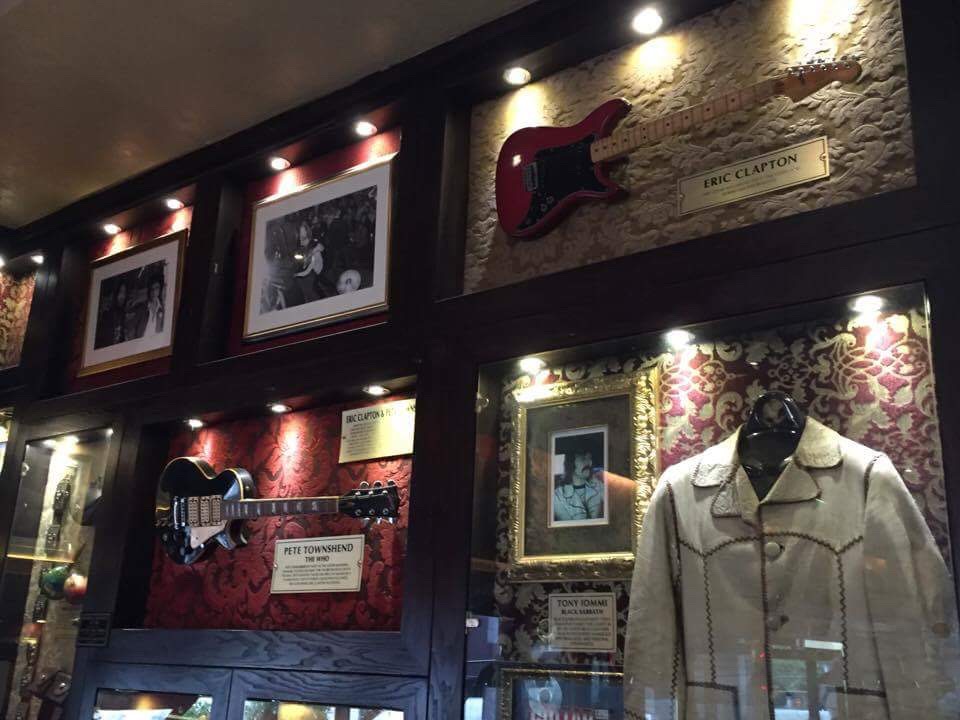
    Making our way towards Trafalgar Square and we spotted a Hard Rock Cafe (Tom always likes to peak at the memorabilia), and wandering in Tom quickly realised we had struck Rock n Roll gold!

    The original Fender Stratocaster left by Eric Clapton to mark his spot at the bar remains exactly where it was placed in 1979, alongside a Gibson Les Paul donated the next day by Pete Townsend of The Who, with the famous note “Mine’s as good as his!” This is the story of how the Hard Rock’s memorabilia tradition all began.

    image

    Chatting to the manager (An Australian guy who shouted us a couple of pints), he told us about the other Rock n Roll treasures just next door.

    The neighbouring Rock Shop featured an underground vault with its most precious rock history pieces. The shop runs free tours every 20 minutes to show off collection items including the Gibson Flying V played by Jimi Hendrix at Woodstock 1969, Jimmy Page’s famous Les Paul Custom and other guitars once belonging to the likes of Keith Richards, David Bowie, BB King, Jeff Beck and many more.

    Other famous pieces include clothing worn by Elvis Presley, John Lennon, Prince and Guns n Roses during famous concerts, film clips and interviews. Needless to say Tom was in is element!

    image

    We joined our ‘Girles Gone Wild‘ friends Steph and Tyrone for an English pub dinner later that night, before heading to West End to see Aladdin. Based on the classic Disney film, the costumes, sets and musical numbers where a feast for the eyes and the magic carpet “I can show you the world” scene was phenomenal! (It’s coming to QPAC in Feb 2018).

    At London’s centre stands the imposing Houses of Parliament, the iconic ‘Big Ben’ clock tower and Westminster Abbey, site of British monarch coronations.

    Having seen the latter two on our last trip, the Political nerd in Jess was buzzing to explore the House of Parliament, which was once a royal palace.

    With Parliament sitting, guided tours weren’t available until after we left London, however all was not lost. We saved ourselves £60 without a tour and instead witnessed the House of Commons sitting from the Public Gallery for free.

    After witnessing Members talk about the devastation Hurricane Irma had caused British islands in the Caribbean, we left to fulfil Tom’s passion in Camden Town – guitars and live music.

    We met up with our mate from back home – Trav – and his lovely girlfriend Amy to hit up a concert at the Electric Ballroom to see Dispatch – a three piece rock band from Boston, Massachusetts.

    It was a fun couple of days in London and having visited twice now, only gave us more motivation to return again.

  • Barcelona to Bruges

    With a few weeks until our next big party (Sail Croatia), it was time to travel north through some key European cities – Barcelona, Paris, Brussels and Bruges.

    Barcelona was our final destination in Spain and after visiting several of its smaller cities, we were keen to see how its biggest tourist draw stacked up.


    Immediately we could see Barca is very different from the rest of Spain. Historically Catalonia is very distinct/nationalistic in its own right, and the locals are increasingly pushing for Catalonia to again be its own nation.

    The city itself bears evidence of, and strongly celebrates, thousands of years of often-brutal history while also having a very modern vibe, courtesy of countless retail shops, beautiful beaches and overpriced restaurants and attractions for the hordes of tourists arriving from every corner of the world.

    We started with a historical walking tour that included ruins of the old roman walls, the city’s beautiful gothic cathedral, and squares that hosted medieval executions, cemeteries and uprisings.


    Later we would explore the weird, arguably wonderful world of Barca’s celebrated architect Antoni Guadi with a visit to Park Guell, as well as several of his famous buildings including Casa Mila, Casa Batllo and the Sagrada Familia.

    Guadi is responsible for leading the controversial modernism style of architecture in the late 19th century and is considered somewhat of a Catalonian national hero.

    Below is a selection of his work, including his most famous – the still unfinished Sagrada Familia (more beautiful on the inside rather than out). As our guide asked, “was he a genius or a madman? You decide”.


    This slideshow requires JavaScript.

    Our second night we travelled up to the tallest peak of Barcelona – Mount Tibidabo.
    Behind the Tibidabo Cathedral del Sagrat Cor which looks down on Barcelona, you will find the most beautiful sunset.

    It was a beautiful spot to soak up the views of Barcelona and crack open some red wine and sangria with our friends.


    Other Barca highlights include basking on its lovely beaches (still got nothing on the Gold Coast), wandering the windy old streets in the gothic quarter, visiting the Magic Fountain light and sound show, and admiring the hundreds of mega yachts berthed in its marina (including one named Nirvana we googled to learn it cost $1million per week to rent 😧).


    We found it an enjoyable city, but certainly one more built around tourism than Madrid or Valencia.

    On a side note, it was very sad to visit the large vigil placed at the top of the Las Rambla tourist district in memorial of the 17 people killed by a terrorist attack on the street only two weeks before our arrival.

    Leaving Barcelona we flew to Paris.

    This was our second visit to the City of Love, and after seeing many of its main attractions in 2015, we were keen to simply soak up a bit of Parisian culture, food and scenery on this short stop.


    We walked around the Montmartre region and visited the Bascilica of the Sacre Cour…


    ….pretended like we knew something about art at the Musee D’Orsay…


    … and spent an afternoon having a cliched romantic picnic / public drinking session under the Eiffel Tour.


    Our last day in Paris was spent visiting some other beautiful sites, including  Saint Chapelle, Luxembourg Gardens and Canal Street.


    We then took a bus from Paris to Brussels and immediately began wandering its streets to become acquainted with Belgium’s capital and the unofficial head of the European Union.


    You could say Brussels is a little bit Paris, a little bit Amsterdam, but that would be selling it well short.

    The city has its own thing going on, not only the monuments, unique museums (Automobile museum and one dedicated to musical instruments) and old town streets, but think waffles, chocolate and frites (fun fact – French fries weren’t created by the French, but the Belgians), as well as a love of comics and in particular Tin Tin.


    After two nights in Brussels we took a train to Belgium’s highly rated ‘not so secret anymore’ town of Bruges.

    The preserved little medieval town, which was once the richest city in Europe, didn’t disappoint. Quiet(ish), charming and beautiful, many parts of Bruges appear to have been taken straight out of the 14th century.

    We explored such sights via a boat tour around its many canals.


    It was in Bruges we also sampled two more of Belgium’s specialties: a big bowl of mussels (yum!) and of course Belgian beer.

    Earlier in the day we took a tour around Bruges’ most famous and authentic family-owned brewery – De Halve Maan Brewer – very interesting and great beer.


    In the evening we were joined by our new Belgium mate we met on our Morocco tour – Henri De Jonghe, or “Henry the Young” in English.

    Henri introduced us to aforementioned mussels, and he and Tom decided to sample as many Belgian beers as humanely possible in one night.

    Such a venture ended up in the only logical place – a hidden jazz and blues club at 2am. When told we’d missed the live music Tom and an English lass named Vicky, who has a lovely voice, decided to do three or four tunes of their own.

    Special thanks to Henri for an awesome night in Bruges. Nursing a nice little hangover, we were off on a bus to London where pubs, west end, and more guitar-related fun awaits.